
7 Aug 2026 ● Andre Boeke
What UK Manufacturing, Engineering & Technology Employers Need to Know About Recruitment in 2026
If you are an employer in the manufacturing, engineering and technology sectors, you will know that recruitment can be a tough gig.
Recruitment across the UK's manufacturing, engineering and technology sectors continues to evolve rapidly in 2026. So, in this article, we will look at some of the things you can consider as an employer as 2026 progresses.
In this sector, recruitment remains candidate-driven and is influenced by changing technologies, demographic shifts and new workplace expectations, especially amongst younger candidates.
From advanced manufacturing and robotics to renewable energy, aerospace, automotive, software engineering and industrial automation, companies and organisations are competing for talent that possesses both technical expertise and adaptable soft skills. We have written about the importance of soft skills and how to measure them in the past.
In these sectors, at the same time, you might find that many of your experienced workers are approaching retirement, while younger generations are entering the workforce with different career priorities.
For you as an employer in the second half of the 2020s, successful recruitment is no longer simply about advertising vacancies.
You will need to have a strategic approach that builds long-term talent pipelines, strengthens employer branding and creates an attractive employee experience from the first application right through to career development programmes.
Here are some of the key recruitment trends and strategies UK manufacturing, engineering and technology you should take into account in 2026.
1. Skills shortages remain the biggest challenge
Whilst there have been improvements in training and apprenticeship provision, skills shortages continue to affect much of the UK's industrial economy.
As an employer, you might find you struggle to fill vacancies when you are looking to recruit qualified:
- Mechanical engineers
- Electrical engineers
- Design engineers
- Manufacturing engineers
- Automation specialists
- Robotics engineers
- Software developers
- CNC machinists
- Maintenance technicians
- Quality engineers
- Process engineers
- Cybersecurity specialists
- Data analysts
- AI specialists
- Project managers
That is a long list. And demand is particularly high in sectors including renewable energy, defence, semiconductor manufacturing, electric vehicles, aerospace and industrial digitalisation.
Rather than waiting for young experienced candidates to become available, successful employers are investing in developing talent internally through graduate programmes, apprenticeships and structured career progression. This gives younger candidates the opportunity to build their career and gain expertise.
2. Young talent is becoming increasingly valuable
Many manufacturing businesses still rely heavily on experienced employees but a significant proportion of these workers are expected to retire over the coming decade.
This makes attracting younger workers a business priority rather than simply an HR objective.
Gen Z employees often value:
- Purposeful work
- Career progression
- Modern technology
- Continuous learning
- Flexible working where possible
- Inclusive workplaces
- Mental wellbeing
- Sustainability
As an employer, if you fail to engage with younger audiences, you might struggle to fill your already difficult to fill future vacancies.
Consider building relationships with schools, colleges and universities as this can significantly strengthen your long-term recruitment pipelines.
3. Manufacturing careers need better marketing
What is people’s impression of manufacturing? Many young people still associate manufacturing with repetitive factory work despite the industry's transformation and that is a message that you need to get across so that you can attract more applicants.
Modern manufacturing increasingly involves:
- Robotics
- Artificial intelligence
- Digital twins
- 3D printing
- Automation
- Virtual reality
- Internet of Things (IoT)
- Smart factories
- Advanced materials
- Sustainable production
As an employer, you need to think of ways to actively showcase these innovations through videos, social media, open days and employee stories, getting the message out there to potential young recruits.
Showing modern facilities and cutting-edge technology can help to challenge their outdated perceptions.
4. Employer branding matters more than ever
Younger candidates increasingly research employers before deciding whether or not to apply for a role.
They want to understand:
- Company culture
- Career opportunities
- Employee development
- Diversity
- Sustainability
- Innovation
- Leadership
- Benefits
- Employee reviews
A weak online presence can reduce application numbers even if you are in a position to offer competitive salaries.
Take a look at your careers website and make sure it reflects the culture of your company and clearly explains what makes your organisation an attractive place to work.
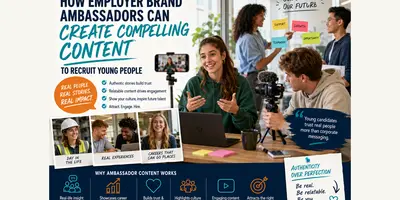
You can find out more here about how to stand out from the crowd with your employer branding. You could also consider using employer brand ambassadors to create content that will appeal to younger people.
5. Apprenticeships are a major recruitment solution
Apprenticeships are still, and will continue to be, one of the strongest solutions to engineering and manufacturing skills shortages.
There are many apprenticeships out there that now cover areas including:
- Mechanical engineering
- Electrical engineering
- Mechatronics
- Digital engineering
- Robotics
- Software development
- Data analysis
- Cybersecurity
- Maintenance engineering
As an employer, expanding apprenticeship programmes to create sustainable talent pipelines rather than relying solely on external recruitment can help you to fill those difficult to fill vacancies whilst also encouraging young people into these fields.
6. Graduate recruitment is becoming increasingly competitive
Because there is a skills shortage in engineering fields, engineering graduates have a wide range of career options available.
If you are an employer in this field, you are competing with employers in:
- Technology companies
- Renewable energy firms
- Aerospace organisations
- Defence contractors
- Consultancies
- Financial services
- Software companies
This is why it is key to be able to communicate to graduates why your company is a great choice for them.
Graduate development programmes, mentoring, rotations across departments and rapid career progression can make your company significantly more attractive.
7. Soft skills are becoming just as important
While technical ability obviously remains essential in these sectors, it is also important to value soft skills when considering applications from school leavers and graduates.
Candidates who demonstrate strong...
- Communication
- Teamwork
- Adaptability
- Problem solving
- Critical thinking
- Leadership potential
- Customer awareness
- Emotional intelligence
...can sometimes be found to outperform technically stronger candidates who might struggle to collaborate and work as part of a team.
Taking soft skills into consideration gives young people a better chance of landing a role within your company. It also gives you the opportunity to assess whether they will be a good fit for your workplace culture.
8. Candidates expect a faster hiring process
If you are struggling to fill your vacancies, take a look at your recruitment process. How long does it take between the first application and offering the job?
Lengthy recruitment processes remain one of the biggest reasons candidates withdraw.
If you have a strong candidate, there is a good chance that they have received multiple job offers.
When you are recruiting new staff, try to:
- Respond quickly
- Minimise interview stages
- Provide regular updates
- Offer prompt feedback
- Make decisions efficiently
Speed and clear communication can be a significant competitive advantage.
9. Salary remains important - but isn't everything
Obviously, a fair salary is always going to be attractive to candidates. But Gen Z are also very keen on researching the overall employment package that you can offer.
As you might expect, competitive benefits may include:
- Flexible working hours
- Hybrid working where appropriate
- Pension contributions
- Bonus schemes
- Health insurance
- Training budgets
- Professional memberships
- Additional annual leave
- Wellbeing support
- Career development programmes
Younger candidates are looking for a career where they can feel valued by their employer and being able to offer other benefits on top of salary goes a long way to doing this.
10. Sustainability attracts young talent
Environmental responsibility has become a significant recruitment factor when it comes to attracting young people to your roles.
Many young candidates actively seek to work for organisations that are committed to:
- Net Zero goals
- Renewable energy
- Carbon reduction
- Recycling
- Circular manufacturing
- Sustainable supply chains
- Ethical sourcing
If you are a manufacturing company that is making genuine sustainability investments then you might find that this is strengthening both your recruitment and your employee retention.
11. Diversity strengthens innovation
Have you made an active effort to create a diverse and inclusive workforce in your company?
Engineering and manufacturing have historically experienced gender imbalance and underrepresentation of several communities.
Having a diverse team of staff can improve:
- Innovation
- Creativity
- Decision-making
- Problem solving
- Business performance
And, of course, broadening your recruitment means you get access to a much wider range of talent.
12. Regional recruitment differences remain significant
As you no doubt know, the labour market varies considerably across the UK.
Some regions experience shortages of:
- Skilled welders
- CNC operators
- Maintenance engineers
- Controls engineers
- Electrical technicians
Meanwhile, in other areas, competition is particularly intense around major technology hubs and manufacturing clusters.
Wherever your company is based, tailor your recruitment so that it reflects local labour market conditions rather than adopting a one-size-fits-all that other, larger, companies might be using.
13. Candidate experience affects employer reputation
Every interaction shapes how candidates view an organisation and we have a more detailed article about this for how to keep your applicants interested during the application process.
Remember that unsuccessful applicants may later become customers, suppliers or future employees.
When you are recruiting, make sure you provide:
- Clear communication
- Respectful interviews
- Timely responses
- Constructive feedback where possible
- Professional onboarding
Positive candidate experiences strengthen employer reputation through word-of-mouth and online reviews.
14. Digital recruitment channels continue to grow
There are many ways that young people find career opportunities and digital recruitment can be a powerful tool for you in these sectors.
As well as job boards, get your company out there so that school leavers and students know about you. Consider:
- Professional networking platforms
- Company careers websites
- Employee referral schemes
- University partnerships
- Industry events
- Skills competitions
- Social media campaigns
- Video content
Using multiple channels helps reach both active and passive candidates.
15. Workforce planning is becoming more strategic
Rather than recruiting only when vacancies arise, keep on the ball by trying to identify times in the future when you might need to recruit new young team members.
Think about strategies such as:
- Identifying any upcoming retirements
- Mapping critical skills that are going to be needed
- Forecasting project requirements - the team you will need to carry out that project successfully
- Investing in future capabilities
This can help you to grow your business into the future.
16. Recruitment is becoming a competitive advantage
Perhaps the biggest lesson for 2026 is that recruitment is no longer simply an administrative function or something that you need to do when you have some physical vacancies to fill.
Consistently attracting, hiring and retaining skilled people means you will be better positioned to:
- Increase productivity
- Deliver innovation
- Meet customer demand
- Expand into new markets
- Improve operational resilience
- Strengthen profitability
- Develop the required technical skills in young people
Your future recruitment strategy will be closely linked to the future success of your company and investing in young people in these areas where there is traditionally a skills gap means you can help to future proof your company and the economy.