9 Mar 2026 ● Andre Boeke
How UK Employers Can Measure Soft Skills in Young Job Applicants
As an employer, when recruiting young people to your vacancies - whether it is for student jobs, Apprenticeships or graduate programmes - there are going to be many instances where applicants have little or no prior experience of the workplace. And there is also a chance that they will not have the necessary hard skills for the roles you are advertising.
This is increasingly the case in the fast moving world we are living in now, with AI and other technology changing the way workplaces operate at pace.
In the modern UK labour market, many employers are now increasingly recognising that technical knowledge alone is not enough when looking to attract young people to job roles. Soft skills such as communication, teamwork, adaptability and problem-solving now play a more important role in determining how effectively young people might perform in real-world environments.
This is particularly important when recruiting young job applicants because many of these candidates have limited work experience. Measuring their soft skills along with any hard skills they might have gives you the best chance of attracting new young talent and helping them to build their career within the workplace.
There are various structured methods that you can use as an employer to measure these abilities and traits in young people fairly and effectively. A combination of methods can help you to gain a clearer picture of a young applicant’s interpersonal strengths and workplace readiness.
Why Measuring Soft Skills Is Important
Being able to target and assess soft skills in younger job seekers is increasingly important. These are the skills that influence how we might interact with colleagues in the workplace, solve problems when challenges arise and how we respond to workplace pressures.
For your young applicants, these abilities can indicate future potential more than formal qualifications alone and they give you a better chance of landing the best talent.
As an employer, you can benefit from assessing soft skills because they help to predict:
- Workplace behaviour
- Ability to collaborate within teams
- Ability to communicate with customers
- Leadership potential
- Adaptability to change
In sectors such as retail, healthcare, education, hospitality and customer service, soft skills can be just as important as technical competencies.
Recruiting a young school leaver or graduate who communicates well, learns quickly and handles challenges constructively can significantly improve productivity in your workplace. And it also gives young people the opportunity to begin their career.
For young people with limited employment history, soft skills often emerge through school projects, extracurricular activities, volunteering, part-time work and even their home life.
So, if you are looking to recruit young people you will need to look at your recruitment process to check that it allows candidates to demonstrate these capabilities rather than simply listing them on a CV or cover letter.
Behavioural Interview Questions
We have written in the past about using different interview techniques - and the types of things you shouldn’t say or ask in interview. Make your interview work well for both yourself and the candidate by giving them the best opportunity to highlight their soft skills.
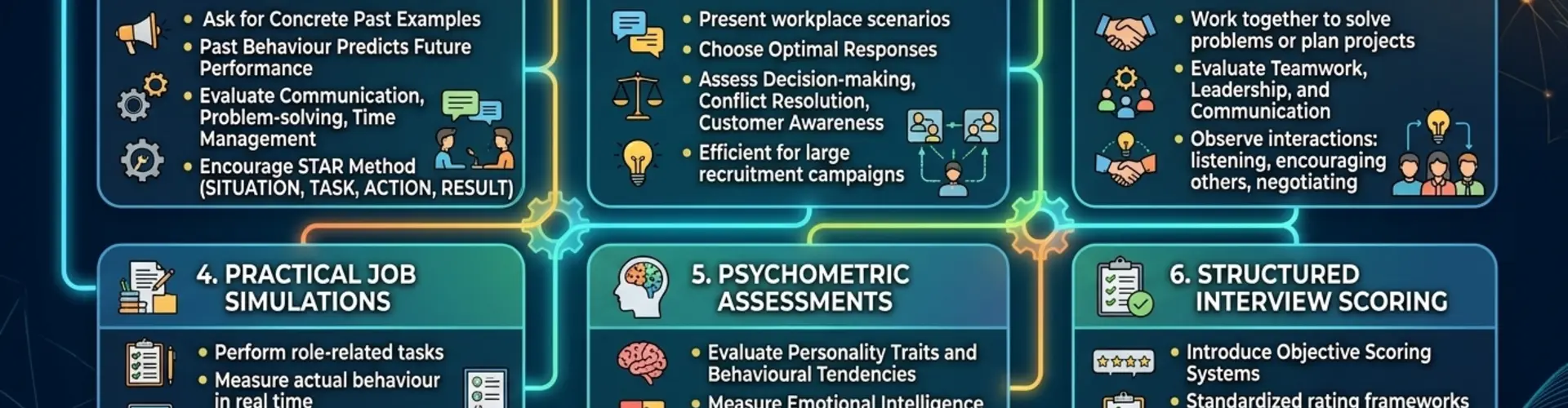
One of the most effective ways to measure soft skills is through behavioural interviewing. This technique asks candidates to describe past situations where they demonstrated specific soft skills. These will be the soft skills that you are looking for - soft skills that you think will be beneficial to your company or organisation.
The principle behind behavioural interviewing is that past behaviour often predicts future performance. Instead of asking hypothetical questions, employers ask applicants to provide concrete examples. These could be questions like:
- Tell me about a time you worked as part of a team to achieve a goal
- Describe a situation where you had to deal with a difficult problem
- Give an example of when you had to manage your time to meet a deadline
Young applicants might draw examples from school assignments, sports teams, volunteer work, part-time jobs or situations that might have arisen with friends or family.
This will then give you the opportunity to evaluate communication skills and how your candidate reacted to certain situations.
You could encourage candidates to use the STAR method (Situation, Task, Action, Result) to help them to structure these responses. This helps them to present their experiences logically and saves you time because it allows you to compare responses more consistently.
Situational Judgement Tests
Situational Judgement Tests (SJTs) present your candidates with workplace scenarios and ask them to choose the most appropriate response. These assessments are widely used in early career recruitment programmes across the UK so they could prove useful to your recruitment if you are not already using them.
For example, you might show an applicant a scenario where a customer complains about a service issue. The candidate must select or rank possible responses based on effectiveness.
SJTs measure several soft skills, including:
- Decision-making
- Communication style
- Ethical judgement
- Customer awareness
- Conflict resolution
Because these tests simulate real workplace challenges, they allow you to get an insight into how your young applicants think and prioritise particular actions.
You might find that SJTs are particularly useful for large recruitment campaigns such as graduate schemes or apprenticeship programmes, where you are going to need to assess many candidates fairly and efficiently.
Group Assessment Exercises
Clearly more suited to larger organisations rather than SMEs who might only be recruiting one or two young people, group assessment exercises are commonly used at assessment centres to evaluate teamwork, leadership and communication skills.
The activities are designed to make sure candidates are put in a situation where they need to work together as a team to solve a problem, plan a project or discuss a business scenario.
For example, applicants might be asked to:
- Design a marketing campaign within a limited time
- Allocate resources to solve a fictional business challenge
- Discuss a community project and agree on priorities
During the activity, your teams can observe how candidates interact with others. They look at behaviours such as:
- Listening to others’ ideas
- Encouraging quieter participants
- Negotiating disagreements
- Sharing responsibilities
- Presenting ideas clearly
For young applicants, group exercises like this can be valuable because it can give them the opportunity to reveal qualities that may not appear on their CV. And you get to see, first hand, how different candidates react in variıus situations. For example, someone who demonstrates respect, cooperation and constructive thinking can stand out as a strong team player.
Practical Job Simulations
Job simulations allow candidates to perform tasks similar to those they would encounter in the role they are applying for. These exercises can be particularly useful for entry-level positions where soft skills play a big role in daily job performance.
If you think this might be useful for the type of roles you typically employ young people for, here are a few examples:
- Responding to a mock customer enquiry
- Writing an email to resolve a workplace issue
- Prioritising tasks in a busy schedule
- Delivering a short presentation
These types of job simulations give you the chance to observe how applicants organise information, communicate clearly and handle pressure. For instance, a customer service simulation might reveal empathy, patience and professionalism.
Work simulations are valuable because they measure actual behaviour in real time rather than self-reported claims on an application form or a CV. Also, young candidates who may struggle to describe their skills verbally can often demonstrate them effectively through practical tasks.
Psychometric Assessments
For a detailed explanation and a look at the advantages of these types of assessments for employers, take a look at our full article about psychometric testing.
Briefly, psychometric testing is another tool used to measure personal attributes and behavioural tendencies. These assessments can evaluate personality traits that influence workplace interactions.
Common traits measured include:
- Emotional intelligence
- Resilience
- Conscientiousness
- Openness to new ideas
- Cooperation
While psychometric tests are not going to be your sole basis for hiring decisions, they can provide useful insights when combined with interviews and other practical exercises.
For young applicants, these assessments can help employers identify individuals with strong potential for learning, adaptability and collaboration. It is quite common for organisations to use psychometric tools during early career recruitment to help them gain a good evaluation of candidates’ potential and suitability for both the role on offer and the company culture.
Structured Interview Scoring
Soft skills are not a black and white area and that means it can be difficult for you, as an employer, to judge whether or not a young candidate has the soft skills you are looking for.
Introducing a structured scoring system can help you to measure soft skills more objectively and clearly. Without clear criteria, you could find you are relying too heavily on personal impressions which can lead to bias.
Depending on the vacancy you are recruiting for, you can develop a basic scoring framework that assesses specific traits that are linked to soft skills.
For example:
Communication skills may be evaluated based on:
- Clarity of expression
- Listening ability
- Confidence in presenting ideas
Teamwork may be assessed through:
- Examples of collaboration
- Respect for others’ viewpoints
- Willingness to share responsibility
Each competency can be rated on a scale, such as from one to five. This type of consistent scoring can help you to ensure that all candidates are evaluated fairly.
Portfolio Evidence and Extracurricular Activities
There is always a chance that young applicants have little or no previous work experience to draw on for examples of their skills. Soft skills, however, are developed in all areas of life so encouraging young candidates to give examples from these areas can give them the confidence to apply for roles.
Ask young people to give you evidence of particular soft skills using examples from experiences such as:
- School or university projects
- Volunteering roles
- Sports teams
- Student societies
- Community initiatives
- Home life
These activities frequently involve leadership, organisation, communication and teamwork.
For example, a candidate who organised a fundraising event may demonstrate planning ability and collaboration. Similarly, participation in team sports may show discipline, cooperation and, sometimes, leadership.
You could ask young applicants to submit a portfolio of examples where they have shown any of the soft skills you are looking for. These can then be discussed at the interview stage.
Reference Checks & Feedback
References from teachers, tutors or previous employers can also provide insights into a young applicant’s soft skills. These referees may comment on reliability, attitude, teamwork and communication style.
Structured reference questions can help gather useful information, such as:
- How well does the candidate work with others?
- How do they respond to feedback?
- Do they demonstrate initiative and responsibility?
References can help to reinforce any observations you might have made or opinions you may have formed during your recruitment process.
Observing Candidate Behaviour Throughout Your Recruitment Process
Soft skills can be evaluated not only during formal interviews and assessments but also just generally throughout the entire recruitment process.
As an employer, you could look out for particular traits and behaviours such as:
- Professionalism in email communications
- Punctuality and preparation for interviews
- Politeness when interacting with reception staff
- Confidence and courtesy during discussions
How a candidate behaves in these situations can often reflect real workplace attitudes. For example, a candidate who communicates clearly and respectfully during scheduling emails may demonstrate strong interpersonal awareness.
Keeping a note of your observations can help you to make that final decision at the end of your recruitment process.
Reducing Bias in Soft Skill Assessment
We have written in the past about banishing unconscious bias from your recruitment process.
Measuring soft skills can bring unconscious bias into play if assessments rely too heavily on subjective judgement. And this means you could be letting top talent slip through the net, ready to be snapped up by your competitors. Employers should therefore adopt practices that promote fairness.
These practices include:
- Using standardised interview questions
- Applying consistent scoring systems
- Training interviewers - including yourself - in objective assessment techniques
- Including diverse interview panels
- Combining multiple assessment methods
- Using a blind recruitment strategy
By structuring the evaluation process carefully, you can try to ensure that all young candidates are given the best chance - those from different backgrounds receive equal opportunities to demonstrate their abilities.
Supporting Development After Hiring
Obviously, measuring soft skills should not end at recruitment. Many young employees will continue developing these abilities once they enter the workplace. You can continue to help them to further develop their soft skills whilst also giving them the training in the hard skills they need to carry out their roles effectively.
You can support this growth through:
- Mentoring programmes
- Communication workshops
- Team-based projects
- Leadership development opportunities
- In house training and opportunities for attending courses in other centres
Providing structured feedback also helps young staff to understand their strengths and areas for improvement.
How Are You Measuring Soft Skills In Young Job Applicants?
Soft skills are essential for workplace success, particularly for young job applicants who may lack extensive work experience. It is therefore important to adopt thoughtful and structured methods to evaluate these qualities during recruitment.
By focusing on potential rather than simply past job experience, you can identify young talent. Those who show the potential of becoming your top performers. Measuring soft skills effectively enables you to build stronger teams, improve workplace collaboration and support the development of the next generation of the UK workforce.
If you are looking to recruit young people - school leavers, Apprentices, students or graduates - to any of your positions, take a look at our services and place your job ad with e4s to gain access to a targeted, engaged audience.