6 Oct 2025 ● Andre Boeke
The Four Jobseeker Personas: Understanding How People Search for Work
What are the factors that drive young people to apply for roles within your company or organisation?
Have you ever considered this? If not, then it could be one of the reasons why you might not be getting the applicants you want. Or when you do manage to land that top young recruit, they don’t stick around for as long as you had hoped.
In today’s competitive job market, not all young jobseekers approach their search in the same way.
We all have different motivations – and school leavers, students and graduates are no different. They have different confidence levels, different life and career goals – and they also face their own challenges.
Recognising these differences can not only help young jobseekers better understand their own strengths and areas for improvement, it can also help you as an employer to tailor your recruitment strategies more effectively.
One powerful way to make sense of these differences is through jobseeker personas. Just as marketers create customer personas to understand consumer behaviour, jobseeker personas can highlight the unique patterns in how young people search for and secure employment.
A jobseeker persona focuses on your ideal candidate’s characteristics, skills, goals and motivations. They also help you to drill down into which candidates you are really aiming to recruit.
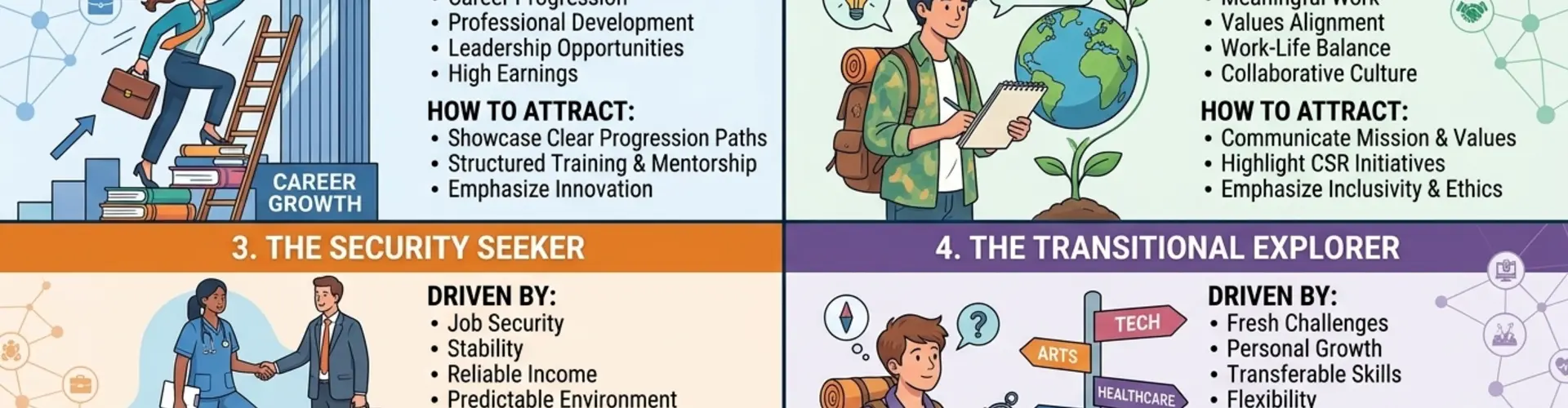
While there are many variations, four core jobseeker personas stand out as particularly common across different industries:
- The Ambitious Climber
- The Purpose Seeker
- The Security Seeker
- The Transitional Explorer
Whilst it is not about fitting all young job seekers into neat pigeon holes, these general areas can give you some ideas about the motivations of your potential candidates.
Each of the personas listed above has distinct goals, traits and challenges.
Let’s take a closer look at each persona and what they might be looking for…
The Ambitious Climber
The Ambitious Climber is driven, focused and determined to advance quickly in their career. They often have a clear vision of where they want to be in five to ten years and see their current job search as a stepping stone toward a larger goal.
Typical Profile Of The Ambitious Climber
The Ambitious Climber is often a younger graduate who might be looking for a graduate role with your company. Or they could be in their early career. The common fields they tend to look for roles in are areas such as finance, tech, law, consulting and other competitive fields.
Motivations
When looking for a new role, the typical Ambitious Climber is looking for:
- Career progression and promotion opportunities
- Professional development and training
- Recognition, influence and leadership opportunities
- High earning potential
Job Search Behaviours
Knowing the typical job search behaviours of the Ambitious Climber can help you to target your recruitment process towards your targeted audience.
The Ambitious Climber:
- Proactively networks online and offline
- Maintains a polished LinkedIn profile and personal brand
- Applies selectively to roles that align with their intended career trajectory
- Negotiates salaries and benefits assertively
- Follows industry trends and seeks out mentors
Challenges
- Risk of burnout due to high self-imposed expectations – there are steps you can take to reduce the risk of burnout amongst your staff
- May overlook roles that don’t fit their exact career plan but offer valuable experience
- Can sometimes come across as overly ambitious or impatient to employers
How Can You Attract The Ambitious Climber To Apply For Your Roles?
- Showcase clear career progression paths and leadership opportunities in your recruitment
- Offer structured training programs and mentorship and make this clear in your job ads as well as your online presence
- Emphasise company growth and innovation
- Be transparent about performance expectations and advancement timelines. This is a win-win as it saves you time and money, giving you a better chance of recruiting the right person. It also saves time for candidates who might decide your company isn’t suitable for them. They can move on.
What Is The Key Takeaway For The Ambitious Climber?
Ambitious Climbers are assets to any organisation because they bring energy and a growth mindset. But they need room to develop and achieve.
The Purpose Seeker
Our next jobseeker persona is the Purpose Seeker.
The Purpose Seeker prioritises meaning, values and impact over financial gain or rapid career progression. They want their work to align with their personal beliefs and make a difference in the world so they will research your company beforehand to make sure you are a good fit for them.
Typical Profile Of The Purpose Seeker
The Purpose Seeker is a common jobseeker persona amongst younger jobseekers and they are likely to be school leavers, students or graduates who excel in more creative subjects rather than STEM subjects.
The Purpose Seeker is likely to be attracted to roles within creative industries, charities and other non-profit organisations and public services such as health, social care and education.
What Motivates The Purpose Seeker?
- Mission-driven work and alignment with personal values
- Work-life balance and wellbeing
- A collaborative, supportive workplace culture
- Opportunities to contribute creatively or socially
Job Search Behaviours
When looking for work, the Purpose Seeker:
- Researches company culture, mission statements and impact reports thoroughly
- Prefers referrals, word-of-mouth and value-aligned job boards over mass applications
- Prioritises organisations known for positive social or environmental contributions
- Will take the time to tailor applications to causes they believe in
Challenges For The Purpose Seeker
- Might struggle to find roles that balance purpose with financial stability
- Can be overlooked by employers who prioritise hard skills over cultural fit
- Sometimes uncertain about how to frame their skills in more corporate contexts
How Can You Attract The Purpose Seeker To Apply For Your Roles?
- Make sure you communicate your company mission, vision and values clearly in your job ads and in your other online content such as your company website and social media
- Highlight any CSR (corporate social responsibility) initiatives and impact metrics
- Emphasise the importance of work-life balance for staff in your company, inclusivity and ethical practices
- Showcase real employee stories that reflect purpose-driven work. Again, this can be done on your social media platforms as well as your company website.
What Is The Key Takeaway For The Purpose Seeker?
Purpose Seekers bring passion, loyalty and creativity to roles that align with their values. They thrive when they feel connected to a larger mission.
The Security Seeker
Now let’s take a look at our third jobseeker persona: the Security Seeker.
The Security Seeker values stability, predictability and a supportive work environment above all else. Again, this has been a common search trait for Gen Z jobseekers.
They are less focused on climbing the ladder quickly or making a dramatic impact. They are more interested in finding a role where they can thrive long-term without unnecessary stress. Job security is key.
Typical Profile Of The Security Seeker
With regards to younger people, the Security Seeker is likely to be one of those people who have had a previous role (or roles) and have been unsettled for some reason. It might have been a role with too much pressure or a role with too much uncertainty and insecurity.
It might also be a school leaver who has completed an Apprenticeship, for example, but their employer was unable to offer them a full time permanent position once qualified.
The Security Seeker will look for work in a variety of industries, depending on their background. Public sector, administration, healthcare, education, logistics and skilled trades are common areas.
What Motivates The Security Seeker?
As you might expect, when applying for jobs, the Security Seeker looks for:
- Job stability and long-term employment
- Reliable income and benefits
- A clear structure and defined responsibilities
- A positive, respectful workplace culture
How Does The Security Seeker Go About Their Job Search?
When searching for a new role, the Security Seeker:
- Applies through established, reputable platforms
- Prioritises companies with a strong track record and low turnover
- Could rely on personal contacts or local job markets rather than national searches
- Often prefers in-person interviews and clear application processes
What Challenges Are Faced By The Security Seeker?
Young people who fall into the Security Seeker category can face the following challenges:
- May be hesitant to apply to startups or companies with unclear prospects. They are not looking for risk
- Sometimes undervalues their transferable skills, limiting their opportunities. They need to be given the confidence to recognise and leverage those transferable skills
- They might be perceived as less ‘dynamic’ in fast-paced industries
How Can You Attract The Security Seeker To Apply For Your Roles?
To attract young security seekers to your vacancies you can do the following:
- Highlight stability, clear contracts, benefits and employee retention rates
- Emphasise work-life balance and supportive management structures
- Offer clear job descriptions and predictable advancement opportunities
- Ensure you have a welcoming, inclusive onboarding process
What Is The Key Takeaway for The Employment Of The Security Seeker?
Security Seekers tend to be dependable, loyal employees who contribute to long-term development and success of the company when they find the right environment.
The Transitional Explorer
Our final jobseeker persona is the Transitional Explorer.
The Transitional Explorer is in a period of change. They may be switching industries, returning to work after a break, relocating or reassessing their career direction.
They tend to be curious, adaptable and they often bring diverse skills to the workplace. But they may also lack clarity about their next steps.
Typical Profile Of The Transitional Explorer
The Transitional Explorer is usually able to tap into their transferable skills quite easily. In the case of young people – school leavers, students or graduates – they may be well qualified or have experience in one particular field but they are willing to explore a whole new field, leveraging their transferable skills.
As such, the Transitional Explorer jobseeker persona tends to be found across all sectors.
What Motivates The Transitional Explorer?
As you might expect, it’s all about keeping things new and fresh for the Transitional Explorer. Their motivations tend to be:
- Exploring new opportunities and directions
- Personal growth, reinvention or better life balance
- A fresh challenge or better alignment with life circumstances
- Flexibility (remote work, part-time options, retraining opportunities)
How Does The Transitional Explorer Search For Jobs?
Typically, the Transitional Explorer:
- Researches different sectors and may apply broadly
- Takes courses, attends workshops and / or networks to build new skills
- Values supportive hiring processes and transferable skill recognition
- May be active on job boards but also relies heavily on informational interviews
What Are The Challenges Faced By The Transitional Explorer?
Sometimes, the Transitional Explorer might:
- Feel overwhelmed by the number of choices and directions
- Might face rejection due to lack of “direct experience” in a new field
- Might need help reframing their past experience for new roles
- Feel a lack of confidence occasionally during the transition and doubt their skills and choices
What Can Employers Do To Attract The Transitional Explorer To Their Roles?
There can be lots of benefits for you as an employer when employing a Transitional Explorer. Not least, their transferable skills and experience which they built up elsewhere. They can bring a new perspective to tackling challenges in the workplace.
If you want to open your doors to the Transitional Explorer, you can:
- Emphasise transferable skills and provide clear pathways for career changers
- Offer internships, returnships or structured onboarding for career transitions
- Highlight training opportunities and flexible arrangements
- Be open to non-linear career paths and diverse backgrounds
What Is The Key Takeaway For The Transitional Explorer?
Transitional Explorers bring fresh perspectives and adaptability. With support, they can become some of the most engaged and loyal employees.
Why Understanding These Four Jobseeker Personas Matters
Recognising these four personas isn’t just an academic exercise. It has real-world implications for both jobseekers and employers.
For young jobseekers, identifying which persona most closely reflects their current mindset can help them to:
- Clarify their goals and priorities
- Focus their job search strategy
- Anticipate and overcome common challenges
- Communicate more effectively with employers
For employers and recruiters, tailoring job postings, employer branding and recruitment strategies to resonate with different personas can:
- Attract more qualified and motivated candidates
- Improve candidate experience and engagement
- Reduce turnover by aligning employee motivations with organisational offerings
- Build a more diverse and dynamic workforce
Job searching is never one-size-fits-all. Young people approach the job market with different motivations, needs and strategies and understanding these can help you as an employer to make your recruitment process more efficient and successful.