1 Sept 2025 ● Andre Boeke
How Employers Can Empower Neurodiversity In The UK Workplace
The landscape of the UK workplace is undergoing a profound and necessary shift – the recognition of, and subsequent empowerment of – neurodiversity.
As businesses increasingly recognise the strategic value of diversity in the workplace, neurodiversity is now also making its presence felt in an increasingly positive way. Clearly, this is a game changer for many young people who are neurodivergent and looking to get into the workplace to begin to build their future careers.
What Does Neurodiversity Mean?
The term ‘neurodiversity’ acknowledges that neurological differences in people are just that; differences and variations in the way the human brain functions.
Neurodivergent people are often those with diagnoses such as:
- Autism
- ADHD
- Dyslexia
- Dyspraxia
Increased awareness of neurodiversity is leading to more diagnoses and many young people are coming out of education armed with the knowledge that they are neurodivergent.
Far from being a niche issue, embracing neurodiversity is a moral, legal and economic imperative for UK employers.
By moving beyond mere awareness of neurodiversity – to taking intentional action to leverage it for the benefit of the company and the workforce – as an employer, you can potentially unlock a vast, untapped talent pool.
A young talent pool that will bring a whole range of different approaches to tackling challenges, that can drive innovation and also help to gradually build a more resilient and compassionate workforce.
But how do you go about embracing neurodiversity and empowering it so that all benefit?
Have You Got A Traditional Workplace Model?
Many of our articles on the Recruiter blog touch on tips to build a more diverse workplace because, unintentionally, many workplaces and workplace cultures have been built around a traditional model.
In the past, this has meant people from different backgrounds – including those who are neurodivergent – have faced barriers to both applying for roles within a company and continuing to succeed and thrive once in their roles.
Some of the barriers that neurodivergent people come up against include:
- Rigid, jargon-filled job descriptions. This can also prove to be a barrier for young people who are neurotypical and we have addressed this in a previous article. Your jargon-filled job ad can be confusing and sometimes meaningless to others, meaning you lose out on potential talent right at the first hurdle
- Rigid, jargon-filled interviews. The same can be said of interviews. Young neurodivergent candidates need to be able to navigate their way through your interview process. This means it might need to be adapted for those who think and process information differently. Prioritising technical ability and skills over social skills, for example
- Open plan offices with overwhelming sensory stimuli
These barriers have led to a startling underrepresentation of neurodivergent talent in the workforce.
Unemployment rates for autistic adults, for example, are disproportionately high. This loss is not just for autistic people themselves but also for the organisations that miss out on their unique and valuable skills.
The business case for neurodiversity is compelling and multifaceted. And it is a win-win situation for both you as an employer and for those younger neurodivergent people who land themselves a role in your workplace.
Neurodivergent people often possess strengths that are highly sought after in the modern economy.
For example, according to Autistica people with autism have many strengths which can serve them well in professional settings as well as in everyday life.
They may demonstrate exceptional attention to detail, pattern recognition and sustained concentration. Many are also loyal people – including showing loyalty to their employers. A great boost for your staff retention.
Dyslexic people often excel at creative problem-solving and big-picture thinking while those with ADHD can bring incredible energy, hyper-focus and innovative ideas to the workplace. Many young people with ADHD will think outside the box and bring a whole new perspective to your organisation.
By harnessing and leveraging these strengths, businesses can gain a competitive advantage in a world that demands new ways of thinking.
Companies that have successfully implemented neurodiversity programmes report benefits such as improved productivity, enhanced problem-solving and increased innovation.
In essence, a neurodiverse team is a more creative and dynamic team.
Employer Responsibilities
Beyond the clear business advantages, UK employers have a legal and ethical responsibility to create inclusive environments.
Under the Equality Act 2010, neurodivergence is often considered a disability. This therefore places a legal duty on employers to provide “reasonable adjustments.”
It is not about giving neurodivergent employees an unfair advantage; it is about levelling the playing field so they can perform their jobs effectively.
How To Empower Neurodiversity In The Workplace
So, how can UK businesses move from simply talking about neurodiversity to truly empowering it?
It is not just about making tweaks to that job ad so that more neurodivergent people feel encouraged to apply for your roles. It is a journey.
And it is a journey that requires a holistic approach, starting from the very first interaction with a potential young recruit right through to extending this throughout their entire career.
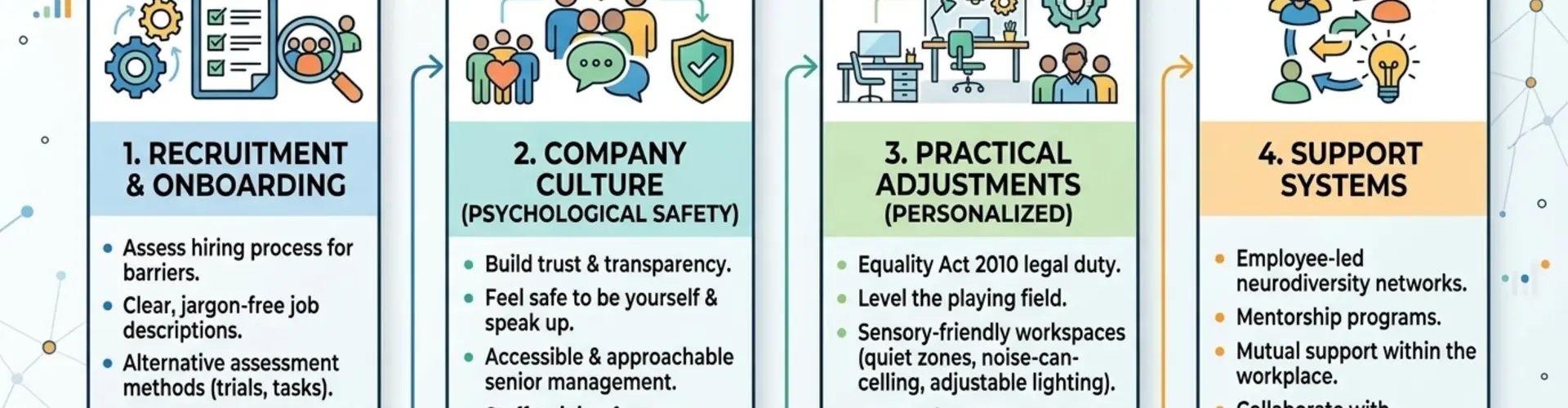
Assessing Your Recruitment & Onboarding Process
The first step is to assess your hiring process.
We have written in the past about writing clear job descriptions for young people. Descriptions that are free from jargon they may not understand.
Similar can apply when you have a neurodivergent audience in mind. Create job descriptions that are clear, concise and focused on essential skills rather than personality traits or communication styles.
As an employer, you should get the message out there that you are showing a commitment to neuro inclusion and make it clear that candidates should feel confident in the request for reasonable adjustments..
Depending on the size of your company, you will use different interview processes. Where possible, take a look at your interview process to see if there are changes you can make.
The interview process itself should be re-evaluated. For example, if you rely on a single, high-pressure interview for choosing your next young recruits, think about offering alternative assessment methods. This can also work for other young people who might not handle interviews too well.
Recruitment could be done through:
- Work trials – this gives both yourself and your neurodivergent candidates space to see how things could work if they were offered a permanent role in your company
- Skill-based tasks
- Providing interview questions in advance. This takes away the element of surprise and allows neurodivergent candidates to plan specific answers
As well as making provisions for neurodivergent candidates, obviously, those on your interview team – including yourself if you are on the panel – need to be trained so that you can recognise certain behaviours and look past these.
These behaviours can include a lack of eye contact during the interview or different communication patterns. Interviewers need to focus on the candidate’s potential and ability rather than their social performance.
When young neurodivergent employees begin their new role, they should also be given tailored, ongoing support. A buddy or mentor system will help all new young recruits in the early days of their role.
Tailored support that addresses the particular needs of your neurodivergent recruits will help them to settle and excel, benefitting both themselves and you as an employer.
Assessing Your Company Culture For Psychological Safety & Transparency
To truly empower neurodiversity, a workplace must be built on psychological safety.
This means creating a company culture where all employees feel safe to be themselves, ask for what they need and speak up without fear of judgement or ridicule. This culture is one that is led by example, so senior members of staff and management need to be transparent and approachable.
Obviously, staff training is going to be needed for this effort; both for management and team members. Everyone needs to be equipped with the knowledge and confidence to support their neurodivergent team members.
This includes understanding what neurodivergence is, how it can manifest itself and how to have the confidence to have open, empathetic conversations about working preferences and necessary adjustments that might need to be made.
Team leaders can work collaboratively with young neurodivergent recruits to find solutions that work for both the recruit and the company as a whole.
Implementing Practical & Personalised Adjustments
Reasonable adjustments are not a one-size-fits-all approach. We are all unique individuals.
So, for example, what works for one person with dyslexia might not work for another. It is important to take a personalised approach and to listen to the individual needs of the person you have recruited.
Common adjustments can include:
- Sensory-friendly workspaces: The British Dyslexia Association suggests the provision of quiet zones such as work spaces away from the noise of busy phones, doors and loud machinery. Noise-cancelling headphones or adjustable lighting can make a world of difference for individuals who experience sensory sensitivities
- Flexible working: Offering flexible hours or hybrid working models can accommodate different energy levels and focus times. Again, this can be discussed with the young employee so that, where possible, their needs can be met
- Assistive technology: Tools like text-to-speech software, mind-mapping apps and digital planners can help with a range of challenges, from reading difficulties to time management
- Clear communication: Providing instructions in both written and verbal formats, highlighting the main points of interest in longer documents, using plain language and breaking down large tasks into smaller steps can help reduce misunderstandings
As an employer, you can make these adjustments available to all employees where possible, without the need for a formal diagnosis.
This “universal design” approach benefits everyone, creating a more inclusive and accessible workplace for all employees, neurodivergent or not.
Building Internal & External Support Systems
Support networks are key to fostering a sense of community and belonging within any workplace.
Employee-led neurodiversity networks or mentorship programs can provide a space for neurodivergent employees to connect, share experiences and offer mutual support.
These networks can also be invaluable for providing feedback to leadership on what is working and what needs to change.
Within these networks, your company can benefit from collaborating with specialist organisations that can help you to move forward with the recruitment of young, neurodivergent job seekers. They can offer specialised training and support.
Empowering neurodiversity in the workplace is a fundamental shift in how we define and value talent. And, for many companies, it offers a path to greater innovation, productivity and resilience and sets you on the path to being a truly inclusive workplace.
A win for your business and a win for neurodivergent job seekers who have much to offer.