11 Dec 2025 ● Andre Boeke
Chancellor Rachel Reeves’ Autumn Budget Statement 2025 – What Does It Mean For Employers?
On 26th November, 2025, Rachel Reeves delivered her second Budget to the House of Commons as Chancellor of the Exchequer. The Budget statement followed months of speculation about tax rises and the Chancellor saying her priorities are cutting NHS waiting lists, the national debt and the cost of living.
And, controversially, any surprises that might have been in the Budget statement were no longer surprises on the day as the OBR (Office for Budget Responsibility) accidentally released their report on the statement before the Chancellor had had the opportunity to make it.
Whilst we pay heed to the Budget statement to see how our personal finances and cost of living will be affected, as employers and business owners, you will also need to dissect what has been said so that you can assess effects on your business – both the good and the not so good.
So, what did Chancellor Rachel Reeves reveal in the November Autumn Budget of 2025? Let’s take a look at some of the key takeaways that could affect you as an employer.
National Minimum Wage & National Living Wage Increase
If you are an employer with staff who are earning the National Minimum Wage or National Living Wage, then you will be affected by the increase awarded to those staff.
This wage increase will largely affect businesses where staff are on hourly rates such as the hospitality sector, retail and warehousing and critics have said this could put extra pressure on you if you are an employer in a small business.
For students and young school leavers who are likely to be doing the type of jobs where they are earning minimum wage, a pay rise is no doubt great news for them.
As an employer, however, for some of you, this wage increase that you will have to find from your business earnings could prove to be a challenge, especially after the National Insurance increase in 2025.
On the flip side, higher earnings for young people means they will now have more spending power so this could boost businesses over time.
The hourly wage increases are as follows:
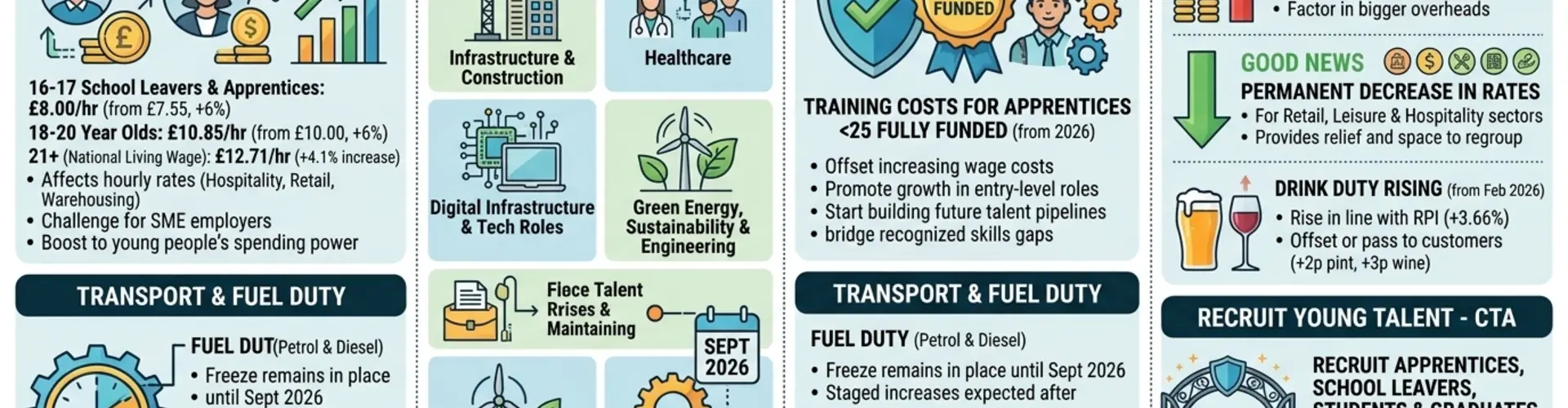
- 16-17 year old school leavers and anyone doing apprenticeships – The new rate is £8.00 per hour. This is a rise of 6% from £7.55 per hour.
- 18-20 year olds – The new rate is £10.85 per hour. This is a rise of 6% from £10 per hour.
- 21+ – Those aged 21 and over are paid the National Living Wage and the new rate is now £12.71 per hour and this is an increase of 4.1%.
Business & Sector Investment
Again, depending on the sector you are operating in, you could have benefitted from the Autumn Budget by way of more Government investment.
Here is what Chancellor, Rachel Reeves, announced in Wednesday’s Autumn Budget statement:
Infrastructure & Construction
If you operate in the infrastructure and construction sector then you could continue to benefit from ongoing Government investment in this sector. This means you could create more jobs and careers for young people in this area, including apprenticeships as demand for skilled and semi-skilled workers in the sector increases.
Healthcare
As with the infrastructure and construction sector, there is ongoing Government investment in the healthcare sector and this means if you are an employer in this area you could benefit from this and also employ school leavers, students and graduates in a variety of roles including administrative positions as well as direct healthcare careers.
Digital Infrastructure & Technology Roles
Ongoing Government investment means you could employ young people in these types of roles, creating graduate programmes and taking on apprentices.
Green Energy, Sustainability & Engineering
Continued investment helps you as an employer to invest in young recruits and train them up in skilled roles.
Support For SME Apprenticeships
The good news for you if you are an employer within an SME (small and medium enterprise) is that if you have previously wanted to take on apprentices but have been put off by the finances around this, from 2026, the training costs for your apprentices under the age of 25 will now be fully funded.
This is also great news for school leavers who are looking to choose the apprenticeship route over full time further and / or higher education because it should mean there are more opportunities around for them to start building their careers in an area they are interested in.
Indeed, it is hoped that the funding will encourage you as an employer in an SME to bring in new young talent into your sector and therefore promote growth in entry level roles across various sectors.
The sectors listed above where there is ongoing government investment are all sectors where apprentices can be employed in a variety of roles and the hourly wage increase announced in this Budget Statement should make the route more attractive to young school leavers.
If you are an employer in a sector where there is a recognised skills gap then apprenticeships can prove to be an effective way to start to bridge this gap and the full funding that has been pledged by Chancellor Rachel Reeves in the Autumn Budget statement for SMEs will go some way to offset any increasing wage costs you might be incurring from the rise in the National Minimum Wage and the National Living Wage.
Business Rates – The Good News & The Bad News
As with any Budget statement, there is always the good news and the not so good news. With regards to business rates, it all depends on where your premises are based and also the sector you are operating in.
The Not So Good News
If your business property is worth more than £500,000 then you are going to need to factor in bigger overheads in the future as your business rates will be increased.
And The Good News
Again, an opportunity to perhaps offset the increases in the National Minimum Wage and the National Living Wage for those of you who are operating in certain sectors.
The Chancellor announced that employers in the Retail and Leisure & Hospitality sectors will have their business rates permanently decreased. In particular, the hospitality sector has gone through – and is going through – some tough times so this decrease in business rates should provide some relief and give SMEs some space to regroup and grow.
Transport – Fuel Duty
Depending on the nature of your business, you could be affected by the announcements made with regards to getting around – transport and how that transport is fuelled.
Once more, Chancellor Rachel Reeves has announced that the duty on fuel – petrol and diesel – will remain frozen. However, the difference this time is that we now have a time limit on that freeze.
The freeze on duty will remain in place until September 2026 and then, after this date, it is expected that there will be staged increases. Something to plan for and bear in mind if you are operating in an industry where you have numerous vehicles.
Lots of people have also made the transition from petrol and diesel vehicles to electric and plug-in hybrid vehicles. If you are an employer who has done this, then you will need to plan for 2028 when a new tax will be levied on these vehicles.
The cost of the tax for electric cars will be 3 pence per mile meaning you could be paying around £20 per week or £240 per year. For hybrid cars, the cost will be 1.5 per mile, equating to £10 per week or £120 per year. This will increase in line with inflation each year.
Hospitality – Drink Duty
If you are an employer in the hospitality industry and you serve alcohol then you will be affected by the Autumn Budget Statement.
The cost of alcohol will rise in line with the Retail Prices Index (RPI). This is a rise of 3.66% and it also includes drinks sold on draught. This will come into effect in February 2026.
If you choose to offset this extra cost by passing it on to your customers, a standard pint of up to 4.5% alcohol volume will increase by 2 pence. Meanwhile, a glass of wine at 12% volume will increase by 3 pence.
Recruit School Leavers, Students & Graduates
These are the key takeaways from the Autumn 2025 Budget Statement where employers will be affected. With regards to the employment of young school leavers, the great news is the funding of training costs for SMEs who wish to provide apprenticeships.
If you are looking to recruit apprentices or you want to recruit school leavers, students or graduates to your company, place your job ad with e4s and reach a targeted audience of young people – some of the best young talent in the UK.