Search
Header navigation

22 Aug 2011 Andre Boeke

Do unpaid positions generate less applications

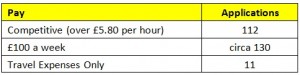
There is a lot in the news at the moment about internships - and the law surrounding paying interns. I'm not going to discuss this here, but instead focus on what our clients are receiving in terms of applications, and how some clients are structuring their positions. We've looked at three of our clients who all recently advertised very similar roles - business development and sales type positions. They were all advertising in London, and are all SME's. One of the clients is paying a competitive wage (over the minimum wage), one is paying £100 per week, and the other is just covering travel costs. internshipapplications As you can see from the table above, the company paying only travel expenses generated 11 applications. The company paying £100 a week though generated around 130 applications - over a tenfold increase. As an interesting aside the other company which offered a competitive wage, received 112 applications. So...
  • Offering some kind of wage can dramatically increase applications
The second interesting point that arises is that offering an actual figure (£100 versus competitive) also seems to increase applications. Put yourself in a jobseekers shoes - and it does make sense. Wouldn't you rather know how much you are going to earn?
  • Try and be as open and clear as possible about wages and pay

I think we've made a pretty good case with just this example to show the link between volume of applications and what pay you are offering, so now I'd like to talk a bit more in depth about the £100 a week scenario. Paying £100 a week £100 a week for an employer is just under the national insurance threshold. It's a very interesting figure as it doesn't make your payroll much more difficult, and doesn't saddle you with extra tax and insurance costs. Effectively at this level - your spend is literally just the £100 a week. So - at this level as an employer you don't have any extra costs. That sounds good - but what can you get from it? Well, if you're paying the national minimum wage then for 18 - 20 year olds you are paying £4.92 per hour and for anyone aged 21 or over £5.93. With a £100 weekly outlay you can get someone to work between 16.5 and 20 hours a week. That gets you roughly 2.5 days a week work.

Summary

I am not arguing for or against the minimum wage in this post, but what I am saying is the following: if you offer an intern a wage you will get more applications for the position. It is also true to say that you will get better candidates (students in our experience will generally apply for higher paid positions over lower ones - depending on what other benefits there are of course!) . The second point is that getting an intern or recruiting someone doesn't have to cost a company that much money. This is a completely separate point, but what I am trying to do is show that getting extra headcount doesn't necessarily have to cost the earth.

Related blogs

Soft Skills Infographic

How UK Employers Can Measure Soft Skills in Young Job Applicants

As an employer, when recruiting young people to your vacancies - whether it is for student jobs, Apprenticeships or graduate programmes - there are going to be many instances where applicants have little or no prior experience of the workplace.
UK Recruitment
UK Recruitment Challenges 2026 Infographic

The Top Challenges Facing UK Employers in 2026

In an increasingly fast-paced world, employers face a whole host of challenges on a daily basis.
UK Recruitment
e4s recruitment roundup infographic 2025

2025 On The Recruiter Blog – A Year In Review

Before we head into 2026, let’s take a look at what was on the recruitment menu in 2025.
UK Recruitment