19 Apr 2026 ● Chris Eccles
UK Employers Aren’t Replacing Graduate Jobs With AI, Despite Growing Student Worries
Lots of UK students and young jobseekers are rethinking their future careers because of AI. Headlines about automation, ChatGPT and disappearing office jobs have made many people nervous about what happens after university or college.
However, new UK research suggests those fears may currently be running ahead of reality.
A report from Prospects at Jisc and the Institute of Student Employers (ISE) has found that while concerns about AI replacing jobs are rising, most employers are not planning major cuts to graduate or entry-level hiring over the next few years.
That does not mean AI will have no impact. It clearly will. But for now, most businesses appear to be adapting roles rather than removing them altogether.
Students Are Worried About AI and Jobs
The survey questioned more than 700 students, graduates and young jobseekers across the UK to understand how AI is affecting career decisions.
It found that:
- 13% have already changed their career plans because of AI
- 34% are thinking about changing direction
- 69% of those who changed plans said they feared their chosen job could be replaced by AI
- 57% said they believe AI is changing the type of work done in their chosen career
That shows AI is already shaping decisions long before many young people enter full-time work.
Instead of only asking, “What job do I want?”, many students are now asking:
- Will this role still exist in five years?
- Will employers still hire graduates?
- Should I move into tech instead?
- Do I need AI skills to compete?
Those are understandable concerns, especially when social media is full of dramatic predictions.
But Employers Tell a Different Story
The same report also asked 30 UK employers how AI is likely to affect early careers hiring.
Their responses were much less dramatic:
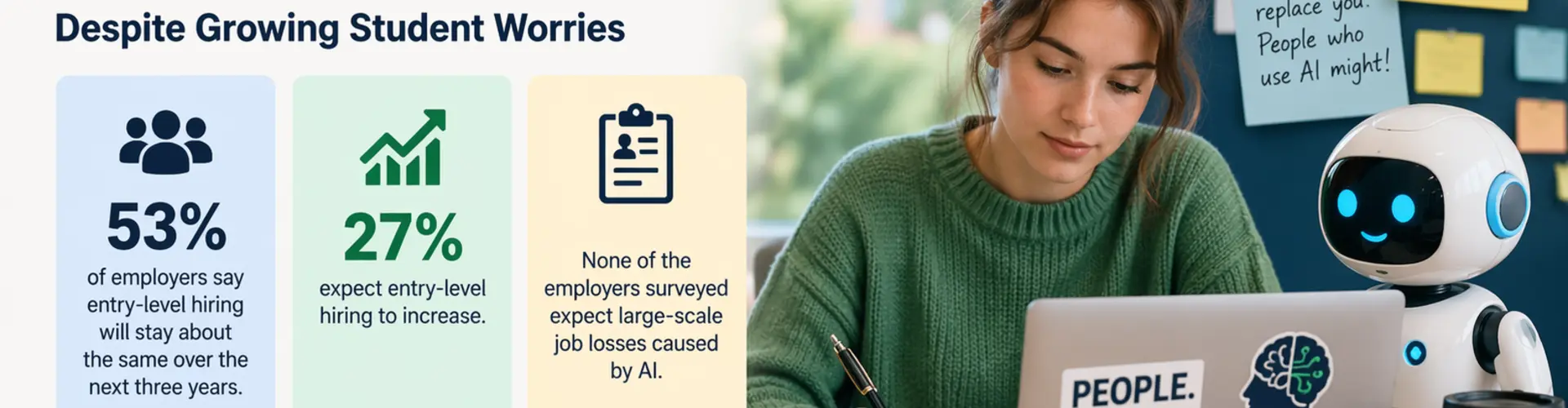
- 53% said entry-level hiring will stay about the same over the next three years
- 27% expect hiring to increase
- None said they expect large-scale job losses caused by AI
- Many said budgets, restructuring and wider economic pressures are having a bigger impact than AI
So while AI is part of the conversation, it is not currently the main reason some companies are hiring less.
That is an important point for graduates to understand. If job openings feel tighter, it may be more about the economy, company budgets or changing business priorities than robots taking over.
AI Is More Likely to Change Jobs Than Remove Them
Many employers said AI is being used to support work rather than fully replace people.
Tasks most likely to be helped by AI include:
- research
- first drafts of written content
- admin tasks
- data handling
- presentations
- information gathering
- routine reporting
These are tasks that can often be sped up with automation.
But employers still see people as essential for:
- communication
- teamwork
- client relationships
- judgement calls
- problem solving
- leadership
- emotional intelligence
- handling sensitive situations
That matters because most graduate jobs involve far more than one repetitive task. Even where AI helps with admin or writing, employers still need people who can think clearly, work with others and make decisions.
Some Sectors May Feel Faster Change
The report suggested that some careers may feel AI disruption more quickly than others.
Areas such as:
- technology
- media
- marketing
- research
- creative work
- translation and language-based roles
were often seen by respondents as more exposed to change.
That does not automatically mean fewer jobs. In many cases, it could mean jobs evolve and new expectations appear. For example, employers may now want candidates who understand AI tools alongside traditional skills.
Students Want Better AI Career Advice
A lot of young people said schools, colleges and universities are not preparing them well enough for a future with AI.
Around:
- 27% of undergraduates
- 29% of postgraduates
said their education was not preparing them very well.
Students said they want:
- practical AI training
- honest advice about which careers are changing
- updates on how employers are using AI
- guidance on future-proof skills
- help using AI responsibly
- clearer information about what AI can and cannot do
That makes sense. Many students do not want scare stories or hype. They want realistic careers advice they can actually use.
What This Means for Young Jobseekers
If you’re worried AI is going to wipe out all graduate jobs, this report suggests that’s not what most employers are saying right now.
Instead, the smarter move is to focus on becoming employable in a changing market.
Build skills AI can’t easily replace
Keep improving:
- communication
- creativity
- teamwork
- leadership
- commercial awareness
- decision making
- adaptability
These skills are valuable in almost every sector.
Learn how to use AI tools
Knowing how to work with AI could give you an edge in applications and interviews.
For example, understanding how AI can help with research, planning, productivity or idea generation may become a real advantage.
Stay flexible
Some roles will change faster than others, but new opportunities are also being created.
The graduates who do best may be the ones who adapt quickly rather than those who avoid change completely.
Don’t Let Headlines Decide Your Career
One of the biggest risks is making career decisions based only on panic-driven headlines.
If you are interested in a sector, research what employers in that field are actually doing. Many industries still need talented graduates and trainees.
Bottom Line
AI is definitely changing the graduate job market. But right now, most UK employers are not replacing graduate roles with AI.
Instead, they seem to be using AI to improve workflows while still relying heavily on people.
For students and young jobseekers, the best response is not panic, it’s preparation. Build strong human skills, learn useful digital tools, stay informed and keep an open mind about how careers evolve.
The future job market may look different, but it still looks like one that needs people.